ULM Introduces Curiak Island Wetland Restoration to Australian Teachers
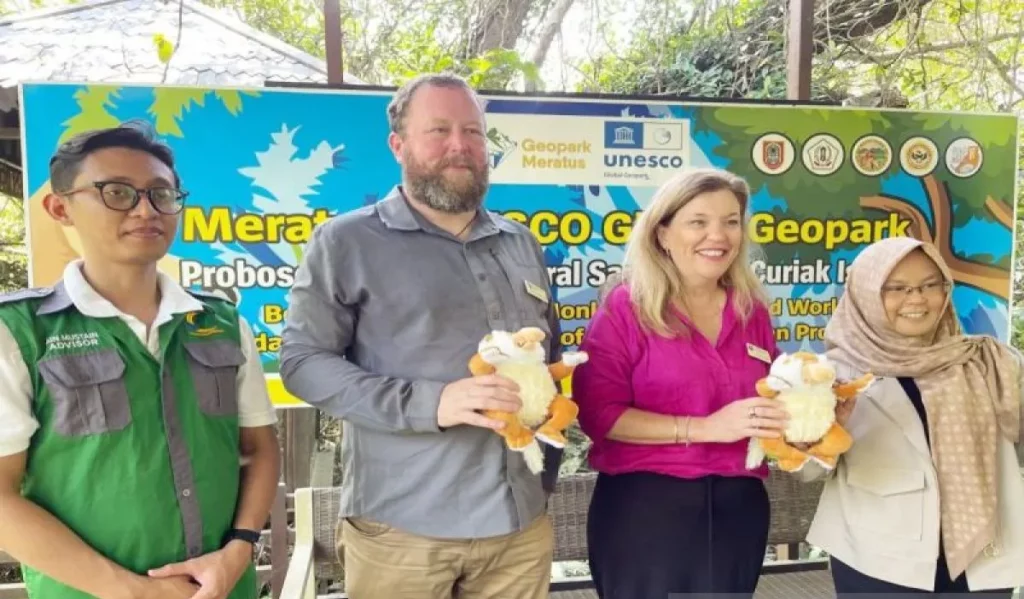
Banjarmasin – Lambung Mangkurat University (ULM) continues to strengthen its role in environmental conservation by introducing the Curiak Island wetland ecosystem restoration program in Barito Kuala, South Kalimantan, to international educators.
The visit was led by two teachers from Bunbury Cathedral Grammar School, Australia, Rob Brooksbank and Roxanne Wilson, who had the opportunity to observe ULM’s efforts firsthand through the Proboscis Monkey Research Station in the conservation area.
“Curiak Island is a natural laboratory for wetland ecosystems that serve as habitat for the proboscis monkey, an endemic animal and icon of South Kalimantan,” said Dr. Amalia Rezeki, a ULM lecturer and the first female doctor of proboscis monkey conservation in Indonesia, during a visit in Banjarmasin on Wednesday (September 24, 2025).
Amalia, familiarly known as Amel, explained that mangrove restoration was initially carried out to save the proboscis monkey, whose population is threatened with extinction due to land use change. “The key to saving the proboscis monkey is protecting its habitat,” Amel emphasized.
The restoration program, which has been running since 2015 by the Indonesian Proboscis Monkey Friends Foundation (SBI) team in collaboration with ULM, not only restores the animal’s habitat but also supports climate change mitigation. Mangrove forests, Amel continued, can absorb up to four times more carbon than ordinary tropical forests.
To date, more than 20,000 mangrove trees have been planted along the Barito River, with the main species being rambai (Sonneratia caseolaris), which serves as a food source for the proboscis monkey and supports the wetland ecosystem.
Rob Brooksbank expressed his admiration for the restoration results. “The trees we saw on Curiak Island, planted in 2018, are now growing into an important buffer zone for the proboscis monkey and various other wetland species,” he said.
This visit not only served as a forum for knowledge sharing but also opened up opportunities for research and educational collaboration between ULM and educational institutions in Australia.
ULM’s efforts through research, education, and wetland restoration demonstrate the commitment of the oldest university in Kalimantan to play an active role in preserving biodiversity while addressing the global challenge of climate change.