Collegium Independence in Medical Education: FKIK ULM Presents National Experts
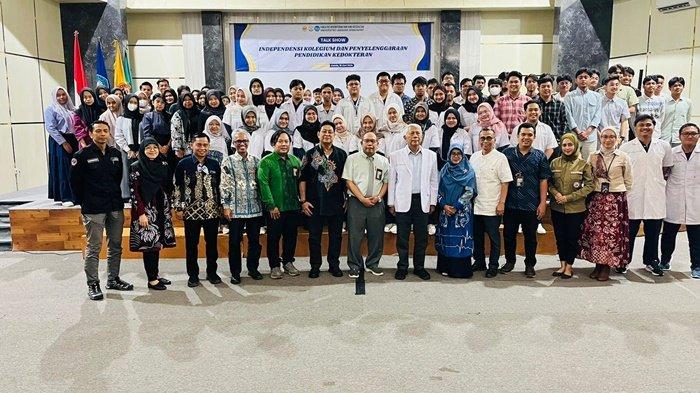
Banjarmasin – The Faculty of Medicine and Health Sciences (FKIK) of Lambung Mangkurat University (ULM) has once again demonstrated its commitment to the quality of higher education, especially in the health sector. Taking place at the FKIK ULM Theater Building, a talk show themed “Collegium Independence and the Implementation of Medical and Health Education” was held by presenting national speakers and enthusiastic participation from the academic community.
This event is part of a series of national movements initiated by professors from medical faculties throughout Indonesia. The Dean of FKIK ULM, Prof. Dr. Syamsul Arifin, dr., M.Pd., FISPH, FISCM, who acted as the moderator, said that this activity was a continuation of the call of academics at the commemoration of National Awakening Day on May 20, 2025.
“This movement is an effort to restore the direction of national health system policy and governance, especially regarding the role of the collegium in medical education and profession, so that it is in accordance with the mandate of the law, including Law No. 17 of 2023,” said Prof. Syamsul.
The talk show presented two professors as speakers. Prof. Dr. Ari Yunanto, Sp.A, Subsp.Neo (K), S.H., a clinician and academic in the field of neonatology, presented the material “Collegium Independence: Review of Ethical, Legal, and Current Policy Aspects.” He emphasized that the elimination of collegium independence would actually erode the supervisory function of the medical profession based on ethics and competence.
“The collegium should ideally remain part of the professional organization and be recognized by the state as a quality assurance partner. The government should act as an approver and supervisor, not a direct controller,” explained Prof. Ari.
Meanwhile, Prof. Dr. Zairin Noor, dr., Sp.OT (K), M.M., delivered his views in the material “Independence of Medical and Health Education Implementation.” He highlighted the disruption of academic autonomy of higher education due to external intervention.
“Ideally, the medical faculty is the ‘kitchen’, the collegium is the ‘chef’ formulating competency standards, and the Ministry of Health is the ‘user’. Therefore, the curriculum and learning outcomes should be prepared by the collegium to ensure that graduates meet professional standards,” explained Prof. Zairin.
This talk show was also enlivened by interactive discussions with students and lecturers of FKIK ULM. Various questions and critical views were raised, especially regarding the potential risks if the independence of the collegium is ignored. Prof. Syamsul reminded students of the importance of understanding this issue objectively.
“Incorrect information if repeated can be considered true. Therefore, students need to spread valid information, for example through videos or poetry during orations, so that their voices are heard by policy makers,” he said.
In closing, the Dean of FKIK ULM emphasized that the independence of the collegium means freedom in carrying out academic and professional functions without external pressure, while the independence of the implementation of medical education refers to autonomy in determining the curriculum, standards, and educational processes.
“We hope that the call from the professors of medicine throughout Indonesia today, from Sabang to Merauke, can reach the ears of national decision makers,” concluded Prof. Syamsul.
Through this forum, Lambung Mangkurat University demonstrates an active role in maintaining the integrity of medical education, while emphasizing the importance of synergy between campuses, collegiums, and the government in building a professional health system that supports the interests of the community.