Digital Era and Public Policy: ULM Presents Discussion with South Kalimantan Police Chief and Professor of Constitutional Law
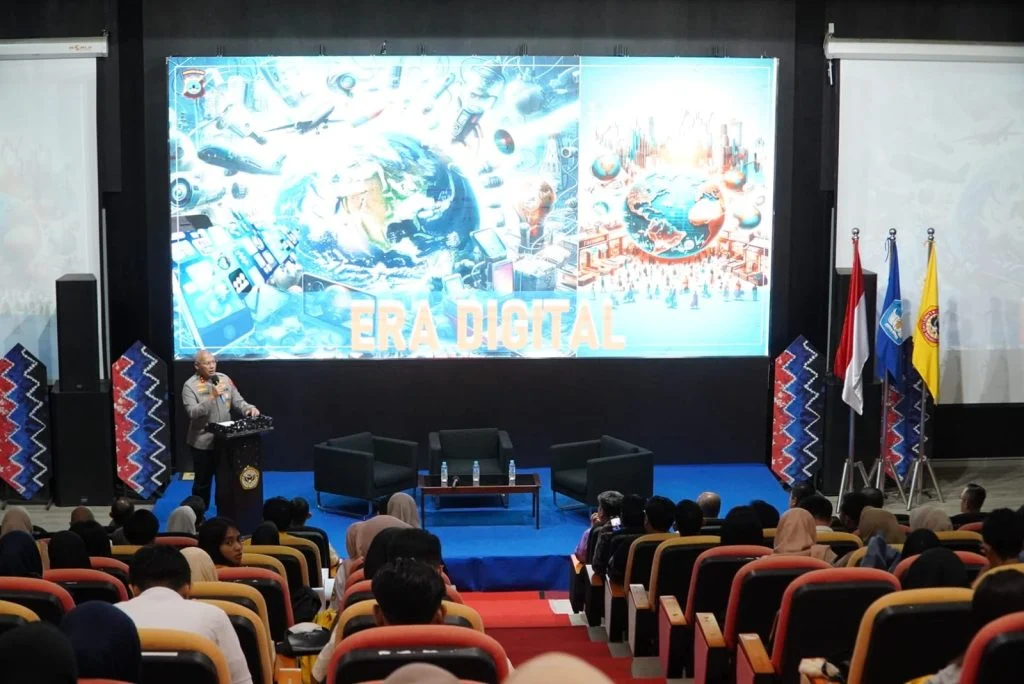
BANJARMASIN – Lambung Mangkurat University (ULM) successfully held a public lecture themed “Challenges and Opportunities for Constitutional and Public Policy in the Digital Era” on Wednesday, (28/5/25) attended by ULM Rector, ULM Senate Chair, ULM Banjarbaru Coordinator, President Director of PT. Bandangan Tirta Agung Chendrawan Sugianto, South Kalimantan Police Chief and staff, lecturers and students in ULM.
The event, which took place at the ULM General Building Lecture Theater, became an important discussion forum regarding the adaptation of the state system amidst the rapid flow of digitalization.
This public lecture presented two main speakers, Inspector General of Police Rosyanto Yudha Hermawan, Chief of the South Kalimantan Regional Police (Kapolda Kalsel), who acted as the keynote speaker, and Prof. Dr. Yahya Ahmad Zein, Professor of Constitutional Law from the University of Borneo Tarakan (UBT) who also serves as the Chancellor of UBT.
In his speech, ULM Rector Prof. Ahmad Alim Bachri emphasized the importance of ethics in the use of technology.
According to him, technical skills alone are not enough. He said that students need to understand the social and legal impacts of using technology.
“Students must not only be able to use technology, but must also be able to use it wisely. Because in the digital world, small mistakes can have big impacts,” he said.
In his presentation, the Chief of South Kalimantan Police, Inspector General Rosyanto Yudha Hermawan, emphasized the urgency of science-based synergy in facing the digital era.
He invited the entire ULM academic community and the people of South Kalimantan to collaborate in finding scientific solutions in order to realize an advanced, safe, independent, and competitive society.
“We must collaborate, provide understanding and awareness to the public to be wise in the digital world. Public policies must be built adaptively and responsively to developments in the era,” said the Chief of Police.
The next session was a presentation by Prof. Dr. Yahya Ahmad Zein, an expert in Constitutional Law, thoroughly examines how digital developments affect almost all aspects of life, especially in the realm of government and the state system.
Prof. Yahya began his presentation by highlighting Indonesia’s strategic position in the global arena. “Indonesia, as the fourth most populous country in the world and with an internet penetration rate of more than 77 percent, has great potential in digital transformation. This condition places Indonesia as a strategic actor in the Southeast Asia region,” explained Prof. Yahya.
According to him, the digital revolution demands a fundamental paradigm shift in the government system. If previously the focus was on conventional power structures, now the government must be able to adapt to the use of data, information technology, and digital platforms in state governance.
This means that the state, which was previously based on a clear power structure, now faces new challenges in integrating big data, artificial intelligence (AI), and digital platforms for decision-making and public services.
Prof. Yahya explained that digital technology has brought revolutionary changes to the government sector. Various countries, including Indonesia, have begun to adopt the concept of e-Government to improve the efficiency of public services.
Furthermore, technology enables the use of big data and artificial intelligence (AI) in the policy decision-making process, as well as supporting the development of smart cities.
“For example, by analyzing big data, the government can have a much better understanding of the needs of the community, allowing for more effective and targeted resource allocation,” he explained.
This shows, said Yahya, how digitalization can create a more responsive and data-oriented government.
The digital era has also significantly changed the landscape of public policy, making it more responsive and adaptive. Prof. Yahya highlighted how digital platforms enable the government to react quickly to changing community needs.
In addition, digitalization facilitates broader community participation in the policy formulation process.
“Open government is easier to realize in the digital era, where policy data and information can be accessed by the public in a transparent manner. Many local governments in Indonesia have used online platforms for public consultations and government performance reporting,” he added.
Prof. Yahya summarized the main focus of public policy in the digital era into three pillars:
- Increasing efficiency and effectiveness: Utilizing technology to optimize bureaucratic processes and service delivery.
- Increase transparency and accountability: Ensure government data and information is easily accessible to the public.
- Increase community participation: Encourage active involvement citizens in the policy-making process.
However, Prof. Yahya did not deny that the digital era also brings major challenges to the state. Cybersecurity issues are a major concern.
“With more open data and information, the potential for misuse, both by external and internal parties, becomes a real threat,” he said.
In addition, inequality in access to technology is a crucial problem. Not all levels of society have equal access to digital technology, which can widen the gap in the acceptance of policies and public services.
Another problem that is no less serious is the spread of hoaxes and disinformation through social media, which has the potential to influence public perception of public policy and even damage social cohesion.
In closing, Prof. Yahya, who is also an alumnus of Lambung Mangkurat University, emphasized that the digital era has an unavoidable impact on the state and public policy. The government must be ready to face challenges while taking advantage of the opportunities offered by digital technology. This era paves the way for more transparent, efficient, and participatory policies, but still requires serious attention to issues such as data security and inequality of access.
“As a society, we must also continue to adapt to these changes in order to actively participate in the process of making better policies,” concluded Prof. Yahya, underlining the importance of a collective role in facing the digital era.
Meanwhile, the Chairperson of the event, Siti Mauliana Hairini, added that this public lecture was a real manifestation of ULM’s commitment to responding to the dynamics of state administration and public policy in the digital era.
“We present the South Kalimantan Police Chief as a representative of law enforcement who understands today’s digital challenges, and a Professor of Constitutional Law to provide an in-depth academic perspective. The digital world demands an active and progressive state role,” she concluded.