Latest Economy: Maintaining Stability, Addressing Reality
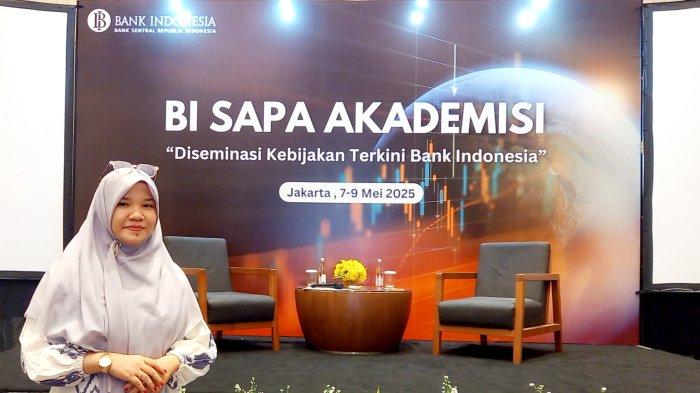
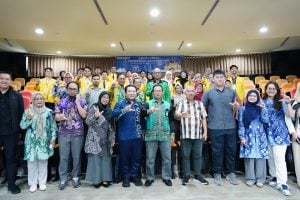
Jakarta witnessed a special meeting between Bank Indonesia (BI) and academics from all over the country in the “BI Greets Academics” forum, held at the DoubleTree by Hilton Hotel Jakarta, on 7-9 May 2025.
A total of 51 academics from various universities attended to listen, discuss, and criticize the direction of monetary, macroprudential, and national payment system policies directly from policy makers.
The event was opened by Mr. Puji Atmoko, Head of the BI Communication Department, and moderated by Ms. Mutia Rahayu. The first session presented Mr. Harry Aginta, Deputy Director of the BI Economic and Monetary Policy Department, with a presentation on the current economic conditions and monetary policy responses resulting from the April 2025 Board of Governors Meeting (RDG).
Global conditions are still volatile. The trade war that had subsided has heated up again, causing the global economic growth projection to be revised to 2.9 percent from the previous 3.2%. Global uncertainty has caused capital outflows from developing countries, leading to safe assets such as gold and the European market.
Domestically, economic growth continues to be supported by bumper harvests, public consumption, and improving investment. Although exports still need to be boosted, the trade balance has a surplus, especially in the non-oil and gas sector. The rupiah was under pressure in early April 2025, prompting BI to intervene in the NDF (Non-Deliverable Forward) market. However, in general, inflation remains under control and economic fundamentals are in fairly good condition.
BI chose to maintain the benchmark interest rate (BI Rate), deposit interest rate, and lending interest rate. This step shows a signal of stability, but still opens up room for responsiveness if pressure increases.
However, in the question and answer session, a critical question arose, namely why did the economic data look good, but in the field there were many layoffs, industry did not absorb labor, and foreign exchange reserves decreased due to new debt?
The question was answered frankly that BI’s policy is forward-looking and is formulated through a comprehensive RDG mechanism. However, macro stability is not immediately felt in the real sector if it is not supported by cross-sector synergy. Monetary policy alone is not enough. It is necessary to optimally utilize domestic potential in order to create jobs and improve welfare.
The second session discussed macroprudential policies delivered by Ms. Sagita Rachamanira, Deputy Director of the Macroprudential Policy Department. In her presentation, it was emphasized that the financial crisis was very costly. Therefore, maintaining financial system stability (SSK) is a must.
Through instruments such as the Macroprudential Intermediation Ratio (RIM), Macroprudential Liquidity Incentive Policy (KLM), and Macroprudential Liquidity Buffer (PLM), BI seeks to maintain optimal financing without sacrificing bank resilience. Although credit risk has increased due to global uncertainty, banking capital remains strong, liquidity is maintained, and payment capacity is still good.
MSMEs remain a concern. Credit to this sector is growing, although still limited. Through the Macroprudential Liquidity Incentive Policy (KLM), BI provides relaxation of the Minimum Reserve Requirement (GWM) for banks that channel credit according to targets, with the hope of encouraging financing to productive sectors.
The last session discussed the payment system presented by Irfan Hendrayadi from the Payment System Policy Department. He likened the payment system to a brake failure if not properly regulated. The main goal is to create a system that is fast, safe, and supports economic productivity.
Digitization of the payment system continues to be encouraged through the 2030 Indonesian Payment System Blueprint (BSPI). The use of QRIS has increased rapidly, interconnection of the interbank system continues to be strengthened, and Bank Indonesia is preparing the Central Bank Digital Currency (CBDC). However, the main challenge is to ensure that the money circulating through this system actually flows into the real sector, not just circulating in the financial sector.
The “BI Sapa Akademisi” event showed that BI is open to input and maintains healthy communication with intellectuals. However, we need to reflect here that no matter how large the foreign exchange reserves are, no matter how sophisticated the payment system is, and no matter how neat the macro indicators are, they will not have a significant impact if money and credit do not flow into the kitchens of MSMEs, into farmers’ fields, into factory machines, or into the ideas of young entrepreneurs in remote areas of the country.
It is time for the government and BI to work together to promote the “democratization of the real economy”. There needs to be fiscal incentives and sectoral policies that are aligned, so that BI’s strategy does not run alone. Banking also needs to be encouraged to be bolder and more progressive in financing the productive sector.
As academics, we bear the responsibility to continue to voice the importance of policy direction will not only maintain the numbers, but also arouse the reality of the people. We need an economy that not only grows, but also greens, heals, and humanizes.
Written by:
Dr. Sri Maulida – Lecturer FEB Universitas Lambung Mangkurat
Published in Opinion Column Banjarmasin Post edition May 28, 2025