ULM Ready to Facilitate Experts to Support the National Food Security Program
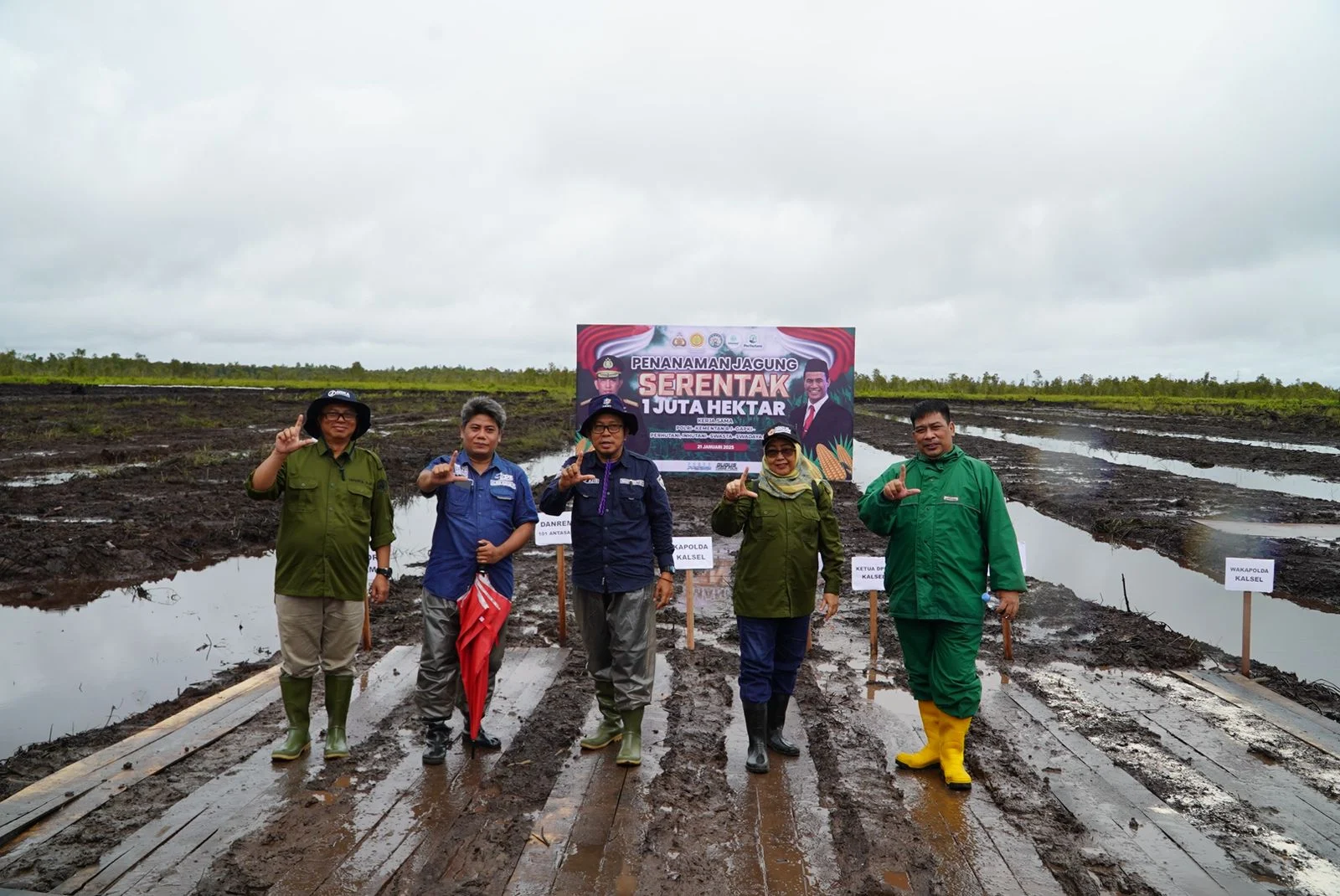
Banjar Regency – In order to support the National Food Self-Sufficiency Program in 2025. The Rector of Lambung Mangkurat University (ULM) Prof. Dr. Ahmad, S.E, M.Si participated in the corn planting initiated by the South Kalimantan Regional Police together with the Regional Leadership Communication Forum (Forkopimda). The Expert Staff of the Governor of South Kalimantan for Community and Human Resources Hj Husnul Hatimah also attended the activity held on Tuesday (21/1/2024).
This planting activity was carried out simultaneously throughout Indonesia, starting with a zoom meeting with the Chief of Police Listyo Sigit Prabowo and the Minister of Agriculture Andi Amran Sulaiman. In this program, corn planting was carried out simultaneously on 1 million hectares of land which is a collaboration between the Police and the Ministry of Agriculture.
According to the presentation of the South Kalimantan Regional Police Chief, Inspector General Rusyanto Yudha Hermawan, from the 125 Ha land that will be planted with corn, some will be used for a haruan fish nursery.
“We plan to open 125 hectares of land for planting corn. Of the 125 hectares, there will be 10 hectares, we plan for a biofloc pond. We will fill this pond with haruan seeds,” he said.
The ULM Rector welcomed this activity. He was also very grateful for ULM’s involvement in every program run by the South Kalimantan Regional Police, especially in food security activities in both livestock and plantations. The ULM Rector further explained that ULM’s involvement in supporting this National program was especially in terms of providing wetland experts owned by ULM
“For example, friends who produce research on irrigation drainage systems that are very much needed in managing wetlands like this,” said the ULM Rector
The ULM Rector hopes that the implementation of this program can become one of the new innovation models in wetland management in South Kalimantan which at the same time empowers unproductive land with corn products produced in the future.