Five ULM Student Business Proposals Pass the 2025 Student Entrepreneurship Development Program (P2MW)
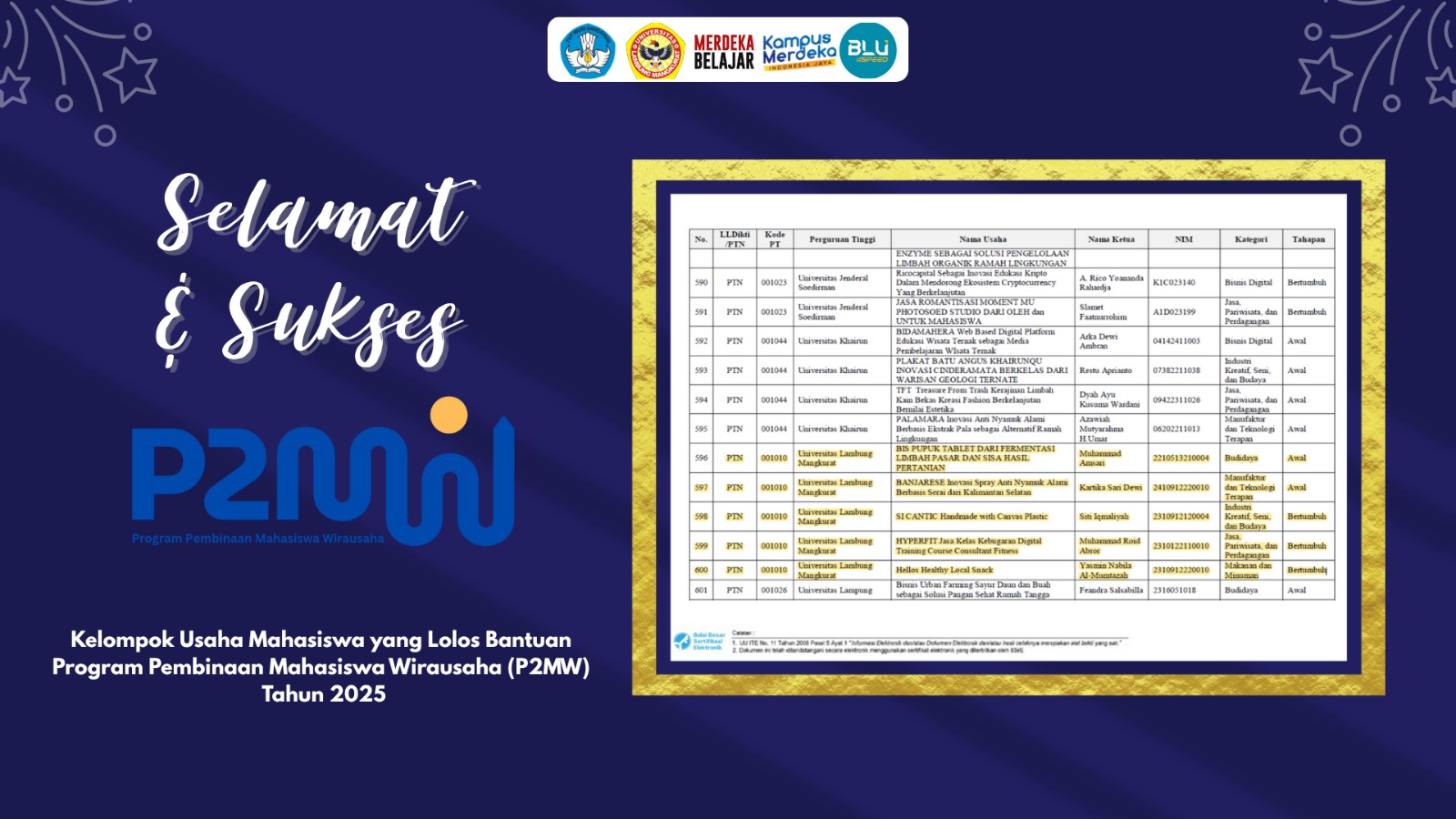
The Directorate of Student and Student Affairs (Ditbelmawa), Ministry of Education and Technology, announced the recipients of the 2025 Student Entrepreneurship Development Program (P2MW) in early July.
Five business proposals from Lambung Mangkurat University students were selected for the 2025 Student Entrepreneurship Development Program (P2MW):
- Business name: “Fertilizer Tablets Made from Fermented Market Waste and Agricultural Residue” – Early Cultivation category, chaired by Muhammad Amsari (2210513210004)
- Business name: “BANJARESE: Innovation in Natural Mosquito Repellent Spray Based on Lemongrass from South Kalimantan” – Early Manufacturing and Applied Technology category, chaired by Kartika Sari Dewi (2410912220010)
- Business name: “SI CANTIC: Handmade with Canvas Plastic” – Growing Creative Industries, Arts, and Culture category, chaired by Siti Iqlamiyah (2310912120004)
- Business name: “HYPERFIT: Digital Fitness Class Services, Training Courses, Fitness Consultants” – Growing Services, Tourism, and Trade category chaired by Muhammad Roid Abror (2310122110010)
- Business name: “Hellos Healthy Local Snack” – Food and Beverage category, Growing category, chaired by Yasmin Nabila Al-Mumtazah (2310912220010)
The 2025 P2MW program has the theme “Indonesian Students with Character, Achievement, and Inspiration.” This program aims to encourage entrepreneurial skills among students by providing entrepreneurial incentives and simultaneously strengthening the entrepreneurial ecosystem within the university environment.
According to the Ministry of Education and Culture (Kemendiktisaintek), P2MW is a program that supports entrepreneurial activities for students who already have product prototypes or are currently running businesses. In line with the focus of the government’s program, in 2025, P2MW will emphasize the application of innovation in business with sustainability as its primary orientation.
This year, there are six business categories for participants to choose from: food and beverage; cultivation; The creative industry, arts, and culture category; the services, tourism, and trade category; the manufacturing and applied technology category; and the digital business category.
From this program, each business is required to produce outputs, including:
- An innovative product or service that has been tested in the market and is ready for mass production;
- A social media account that describes business activities, marketing, and other aspects;
- Business legality, at a minimum, a Business Identification Number (NIB).
The program is scheduled to run from July to November, with the culmination of the KMI Expo, planned for the third week of November.