Impactful Community Service Program: ULM Students Process Crab Shell Waste into Economically Valuable Flour in Sungai Lembu Village
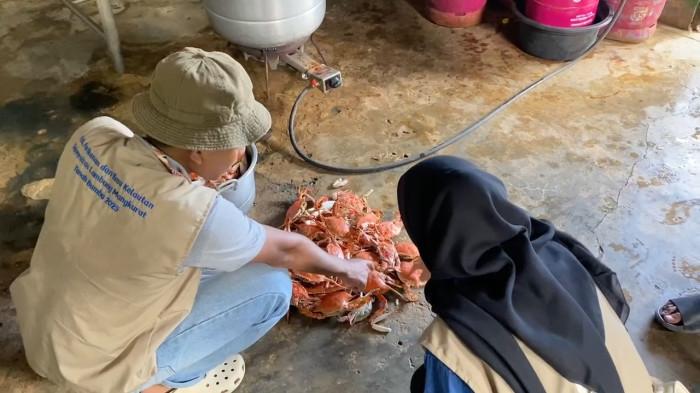
Tanah Bumbu – Lambung Mangkurat University (ULM) has once again demonstrated its contribution to developing local potential and addressing environmental issues through the Thematic Community Service Program (KKN). A group of 13 students from the Faculty of Fisheries and Marine Sciences (FPIK) of ULM, assigned to Sungai Lembu Village, Kusan Hilir District, initiated an innovation that processes crab shell waste into calcium flour with nutritional and economic value.
The activity, which has been ongoing since early August 2025, began with the students’ observation of the village’s potential.
“We discovered that Sungai Lembu Village is a producer of crabs, but the shell waste has been discarded, causing pollution. From there, we were inspired to utilize it with a zero-waste principle,” said Aditya, a representative of the KKN students.
The process of making crab shell flour is carried out in stages, starting with collecting the shells from collectors, cleaning the remaining meat, boiling them at a controlled temperature, drying them for 2–3 days, reducing the size, grinding them with a dry mill, and packaging them. This flour is then tested as a mixture for making mackerel nuggets, along with wheat flour, eggs, and ground spices.
The Head of Sungai Lembu Village, Rusniansyah, expressed his appreciation for the ULM students’ initiative.
“Until now, crab shells have been a waste product. Now, in addition to producing meat, we have a new potential source of the shells. This can increase income and create job opportunities for residents,” he said.
The Tanah Bumbu Fisheries Service also believes this program aligns with efforts to manage fishery resources sustainably. Calcium flour from crab shells offers health benefits, including preventing osteoporosis and improving mineral intake. The product is currently undergoing laboratory testing to determine the exact calcium content.
According to Aditya, this processing not only reduces environmental pollution but also opens up opportunities for food product innovation.
“This flour can be used to fortify various processed foods such as meatballs, biscuits, or snacks, while also enhancing their nutritional value,” he said.
Through this program, ULM not only teaches appropriate technology but also instills an entrepreneurial spirit and environmental awareness in the community. This activity demonstrates the university’s role in implementing the Tri Dharma (Three Pillars of Higher Education), particularly community service, with results that can be directly felt by residents.