Animal Husbandry Study Program and Karya Harapan Farmers Group Utilize Mountain Supan to Boost Buffalo Livestock Productivity
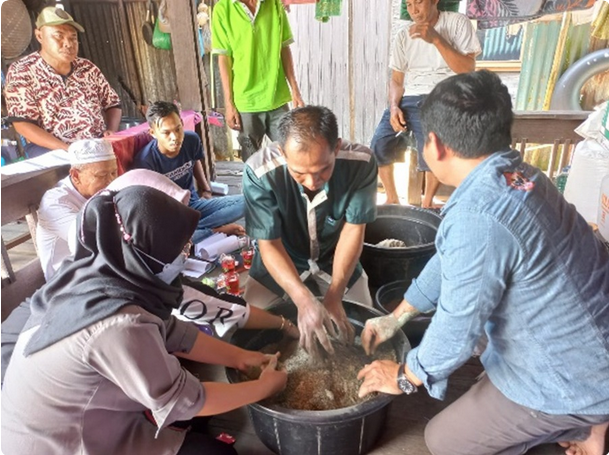
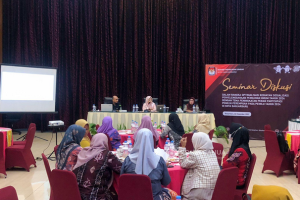
KANDANGAN – Lecturers from the Animal Husbandry Study Program, Faculty of Agriculture, Lambung Mangkurat University (ULM) have launched a community service initiative by providing education to the Karya Harapan Farmers Group in Teluk Haur Village, North Daha District, Hulu Sungai Selatan Regency, South Kalimantan. The focus of this activity is the use of mountain soup as a substitute for milk for buffalo calves, with the main aim of increasing livestock productivity and reducing the mortality rate of buffalo calves.
Dr. Ika Sumantri, as head of this service team, said that this activity was carried out from August to October 2023, involving various stages such as socialization to assistance in making milk substitute feed formulations. “Increasing the value of mountain supan as an alternative feed is expected to have a positive impact on the survival and productivity of buffalo,” said Dr. Ika Sumantri.
One of the aspects explained by the service team was the decline in productivity of kalang buffalo and the high mortality rate of buffalo calves. Dr. Ika Sumantri, emphasized that new knowledge about the use of mountain supan-supan as an alternative feed ingredient could be a solution. “We hope that through this education, farmers will be able to increase their knowledge and skills in processing milk substitute feed for buffalo calves,” she added.
Karya Harapan Livestock Group, as the main beneficiary of this activity, seemed enthusiastic in participating in the entire educational series. This education is very beneficial for farmers because it increases new knowledge regarding the use of local plants, especially mountain supan-supan, as alternative feed. With this new knowledge, livestock groups can apply correct feed processing techniques to support the growth and health of buffalo calves.
It is hoped that this effort can become a model for similar initiatives in other regions, which in the end can make a positive contribution to the welfare of breeders and agricultural development in the area.

You may also like
ULM will have 118 professors by the end of 2023