Community Service Program from the Faculty of Mathematics and Natural Sciences (FMIPA) of ULM: Bioactivator Innovation for Organic Farming in Banjarbaru
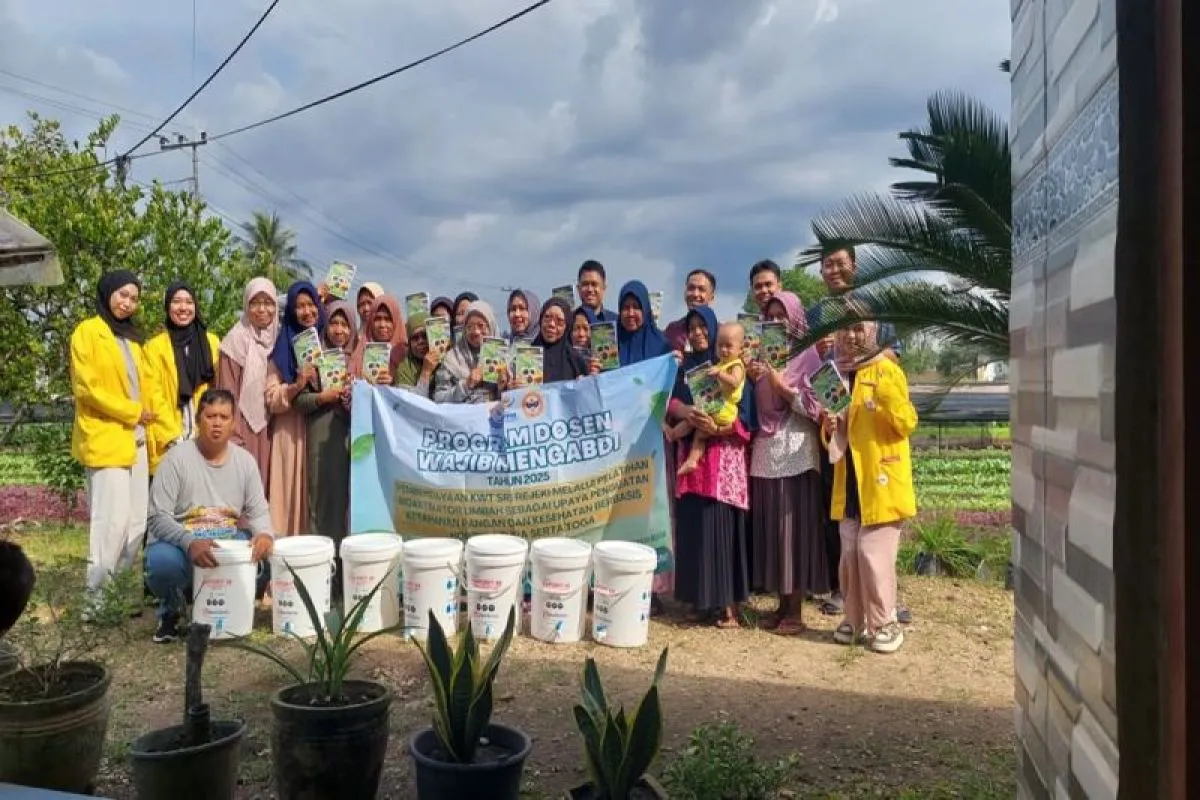
Banjarbaru – Lambung Mangkurat University (ULM), through a team of lecturers from the Department of Pharmacy, Faculty of Mathematics and Natural Sciences (FMIPA), provided training to the Sri Rejeki Banjarbaru Women’s Farmers Group (KWT) on producing environmentally friendly compost based on horticultural waste and medicinal plants (TOGA).
The activity, which took place in Banjarbaru, was carried out as part of ULM’s Community Service (PkM) program. The training was led by Deni Setiawan, Head of the FMIPA ULM Lecturer Service Team, who emphasized the importance of organic waste management to support sustainable agriculture.
According to Deni, the community was very enthusiastic about participating in the activity, which began with a socialization and continued with hands-on practice in making bioactivators. Vegetable waste, which is usually thrown away, can be fermented with the addition of medicinal plants such as lemongrass, galangal, and ginger, which contain natural bioactive substances that repel pests. “This simple technology not only reduces environmental pollution but also improves soil fertility and protects plants from pests,” explained Deni.
In the practical session, participants were invited to chop vegetable waste, mix it with additional ingredients, and then undergo the fermentation process. The fermentation results have been proven to improve soil structure, making it looser and healthier.
“This activity is a concrete manifestation of the synergy between universities and the community. Lecturers not only impart knowledge but also help create solutions based on local wisdom,” added Deni.
The head of the Sri Rejeki KWT, Sukamti, welcomed the mentoring program provided by ULM.
“We’ve had difficulty controlling pests without chemical pesticides. With this bioactivator, we are more confident in farming healthily while maintaining soil quality,” she said.
She added that this innovation aligns with government programs to promote sustainable organic farming and increase farmer independence in managing organic waste.
With this activity, ULM again demonstrates its role as a university driving innovation in the community, particularly in supporting environmentally friendly organic farming in South Kalimantan.